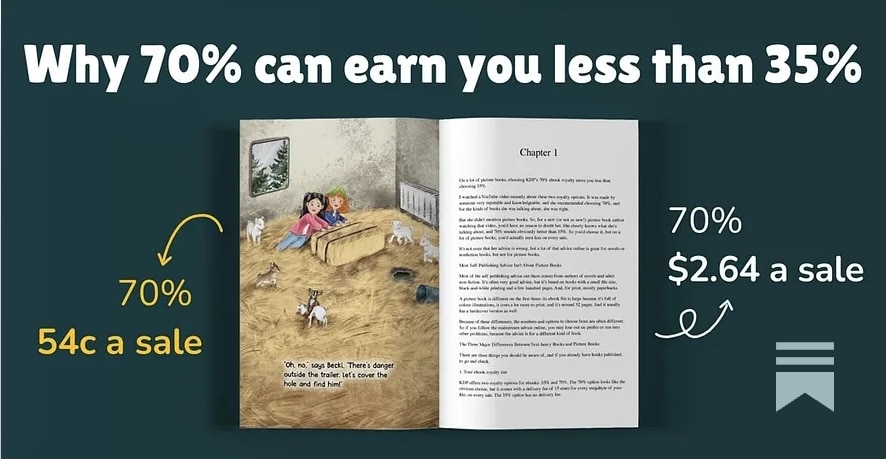
Why 70% Can Earn You Less Than 35% on a Picture Book
The KidLit Creator’s Chronicle – Issue #68
On a lot of picture books, choosing KDP’s 70% ebook royalty earns you less than choosing 35%.
I watched a YouTube video recently about these two royalty options. It was made by someone very reputable and knowledgeable, and she recommended choosing 70%, and for the kinds of books she was talking about, she was right.
But she didn’t mention picture books. So, for a new (or not so new!) picture book author watching that video, you’d have no reason to doubt her. She clearly knows what she’s talking about, and 70% sounds obviously better than 35%. So you’d choose it, but on a lot of picture books, you’d actually earn less on every sale.
It’s not even that her advice is wrong, but a lot of that advice online is great for novels or nonfiction books, but not for picture books.
Real quick: just a reminder that the Escape the Plot Forest Summit is currently underway. It’s truly one of my favourites, and my talk goes live today! It’s free, so check it out.
Most Self-Publishing Advice Isn’t About Picture Books
Most of the self-publishing advice out there comes from authors of novels and adult non-fiction. It’s often very good advice, but it’s based on books with a small file size, black-and-white printing and a few hundred pages. And, for print, mostly paperbacks.
A picture book is different on the first three: its ebook file is large because it’s full of colour illustrations, it costs a lot more to print, and it’s around 32 pages. And it usually has a hardcover version as well.
Because of these differences, the numbers and options to choose from are often different. So if you follow the mainstream advice online, you may lose out on profits or run into other problems, because the advice is for a different kind of book.
The Three Major Differences Between Text-heavy Books and Picture Books
There are three things you should be aware of, and if you already have books published, to go and check.
1. Your ebook royalty tier
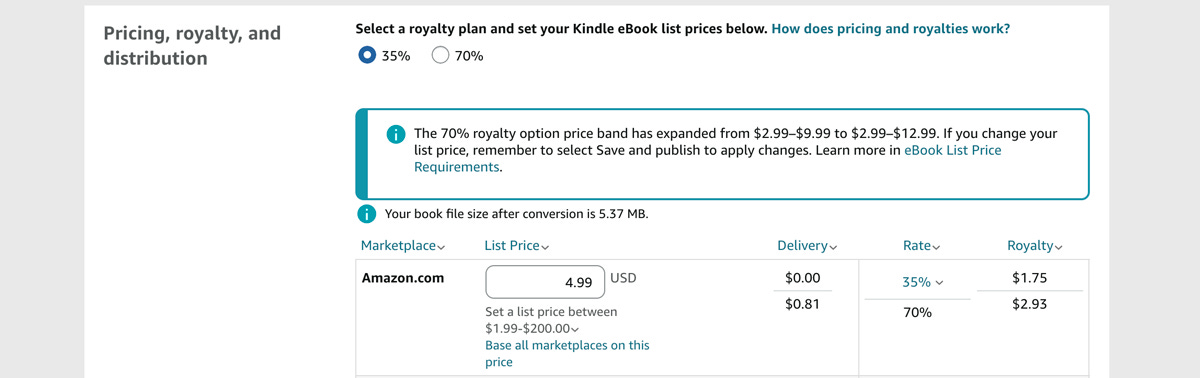
KDP offers two royalty options for ebooks: 35% and 70%. The 70% option looks like the obvious choice, but it comes with a delivery fee of 15 cents for every megabyte of your file, on every sale. The 35% option has no delivery fee.
A novel’s ebook file is usually around one megabyte, so the fee is inconsequential. But a picture book ebook is often 15 megabytes or more, which means you’re paying a lot more for each delivery on the 70% tier.
At 15 megabytes, the delivery fee is $2.25 per sale. If your ebook is priced at $3.99, you earn 54 cents on the 70% tier, and $1.40 on the 35% tier.
This one isn’t a black-and-white rule, though. I can’t tell you you should put your picture book on the 35% or the 70% tier because it depends on your file size and your price. As a rough guide, 70% only earns more once your price is above:
- about $4.29 for a 10-megabyte file
- about $6.43 for a 15-megabyte file
- about $8.57 for a 20-megabyte file
Check your file size, then look at your earnings for both options on the KDP pricing page before you choose. And, if your file size is over 15 MB, ask your book designer (formatter) if they can optimize your ebook file to make it smaller. That means you can more easily make more money on each sale.
***
2. IngramSpark discount and returns
When you publish on IngramSpark, there are two settings that affect whether bookstores will order your book.
The first one is your retail discount, which is the percentage of each book sale that goes to the retailer. The standard bookstore discount is 55%.
The second setting is whether your book is returnable, which means bookstores can return unsold copies to you (or destroy them), and you pay for these.
The standard advice is 55% and returnable, because that’s what bookstores prefer. It’s true that it means you can get into more bookstores, and for a novel, that setup can work. But a print-on-demand picture book costs so much to print that 55% usually leaves you with a loss on every copy, and returns can add to that loss.
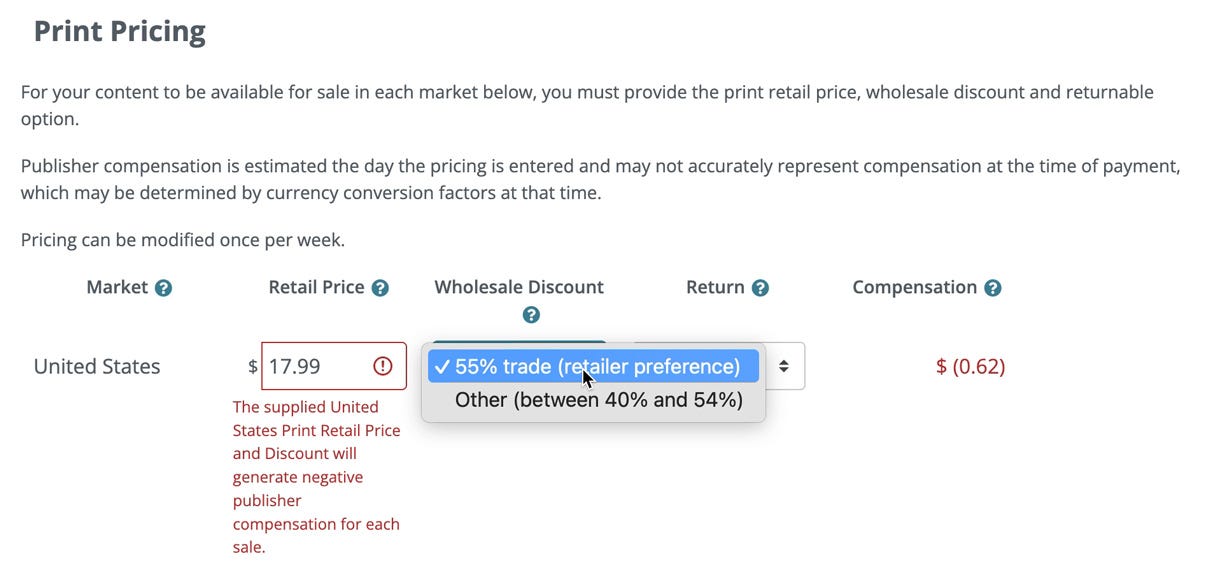
For most picture book authors, I recommend starting at 40% and non-returnable. Fewer bookstores will order your book, but bookstores and libraries can still order it, and you make a profit on every copy. Having a few bookstores order your book while you earn on each one is obviously better than making a loss on each sale.
***
3. KDP Select
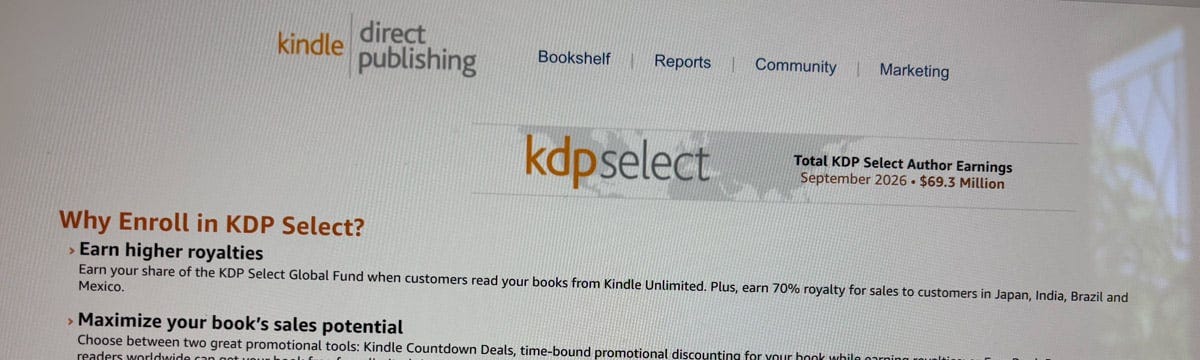
When you publish your ebook, you have to choose whether to enrol in KDP Select or not. It’s an agreement where you sell your ebook only on Amazon, so it can’t be on Apple Books, Kobo or anywhere else during that time. It’s active for 90 days, after which you can cancel if you prefer.
KDP Select gives you two benefits.:
- Kindle Unlimited. This is an Amazon subscription service, where readers pay a monthly fee and can read as many enrolled ebooks as they like. Instead of a royalty per sale, you’re paid for each page a subscriber reads. For a 300-page novel, that can add up to well over a dollar per read. But for a picture book, you only get around 15 cents if someone reads your whole book. So this isn’t a big earner for picture book authors.
- Free promotion days. KDP doesn’t let you set your ebook price to free, but KDP Select gives you up to five days in each 90-day period where you can make your ebook free to download. You don’t earn royalties on those downloads, but it can be a great promotional tool, for instance, to get a lot of downloads and reviews during your launch or at other times, which means Amazon will often start showing your book to more people. So for picture book authors, the free promotion days are much more valuable than Kindle Unlimited.
If you do enrol, set a reminder, because KDP Select renews automatically every 90 days. You can obviously stay enrolled if you want to, but with a reminder you get the chance to decide what’s best for you.
So Which Advice Should You Follow?
Not all of the “general” or novel advice is wrong for picture books. Some of it just depends on your book, like the royalty tier. If your picture book has simpler illustrations and is optimized well, the file size can be small enough to earn more on the 70% tier. So, it’s not always best to choose 35%. You have to check your own numbers.
The IngramSpark discount is different. Because POD picture books are expensive to print, if you give a 55% discount, you’ll often lose money on each sale. Or you have to price your book so high that hardly anyone will buy it anyway.
The exception is bulk printing. When you print a few hundred or thousand books at a time, the cost per copy drops a lot, and a bookstore discount becomes affordable. This comes with its own pros and cons, so if you’d like to know more, I wrote about it in Issue #44, Choosing the Right Printing Option for Where You Are, and in this article I wrote for MCRL Printing: Doors Bulk Printing Opens That POD Can’t.
A Real Example
An author contacted me a while ago because she wasn’t making any money from her IngramSpark sales. She was selling a decent number of books, but her earnings were tiny. When we looked, she had set her discount at 50%, and she hadn’t paid attention to how much she got for each sale.
I don’t recall the exact numbers, but let’s say her book cost $8.38 to print, which is a real IngramSpark print cost for a picture book, and she priced it at $17.99.
At a 50% discount, the bookstore takes $9, which leaves $9. Take off the $8.38 printing cost and IngramSpark’s small distribution fee, and she earned about 28 cents a copy.
At 55%, the standard bookstore discount, she’d lose about 62 cents on every copy.
At 40%, she’d earn about $2.08 a copy.
Since she was selling copies, I encouraged her to look at bulk printing. If she did so and paid around $5.50 a copy, the full 55% discount would give her about $2.26 a copy. And she could sell more copies, because she offered the full discount bookstores want.
Over to You
Take a few minutes and check any of these you’re not 100% certain on already: your ebook file size and which royalty tier you chose, your IngramSpark discount and returns settings, and whether you’re in KDP Select and why. Check your numbers and make sure each one is the right choice for your book.
And I’d love to hear from you! Which piece of self-publishing advice have you followed that turned out not to fit your picture book? Or, if you’re not published yet, which one (or more) of these three things didn’t you know? Let me know in the comments.
It can be hugely helpful to listen to advice from experienced authors. Just remember to always check if it applies to your book.