AI won’t improve your manuscript. You will.
What actually separates a real picture book from an AI one, and a good one from a bad one. – The KidLit Creator’s Chronicle – Issue #66
Recently, I was about halfway through a manuscript when I became quite convinced the person had used AI to help write it.
It’s hard for me to say exactly what I spotted. It was a few things, like specific word choices and the way some words were strung together. And the writing sounded lyrical, but it felt off, like an imitation of good writing. And the story didn’t make me feel anything. Because of my hunch, I ran it through Pangram, a reputable AI detection tool. Pangram said it had significant AI content.
The point here is not to drag anyone through the mud, but two things, really. Firstly, it was immediately off-putting for me because of the way it was written. But more so, it was a poor-quality manuscript that failed at what the author was trying to do, which was to bring across a sweet and important message.
To mention only a few issues: there was a huge amount of description, which is not suitable for a picture book. It was verbose, with flowery, grown-up language and spelled out the lesson.

Why am I being so harsh about this manuscript? I’m trying to show clearly that AI doesn’t write a good book, and it won’t rescue your manuscript either if you don’t know writing craft.
AI has got quite good at producing the “structure” of a picture book. Short text. One idea per page. A character that stays mostly consistent. Type in an idea, and a minute later you have something that looks like a finished book.
A book is not its structure.
Everything that makes a picture book worth reading is beyond the structure. Structure is important for creating a story that works, but it’s not what makes a picture book memorable or what makes kids want to read it again and again. These things come down to the emotional moments and specific or surprising choices that no template can ever produce.
The structure is really like a shell, but what we put into it is what matters.
AI can make the shell, but it can’t make what fills it well.
A little aside
A quick note before I go on: I’ve written quite a bit about AI, so I want to clarify how this article is different.
The main reason I’m against using AI to write children’s books isn’t because the books turn out badly (though they do). It’s that books greatly influence how children think and grow. That’s a human-to-human thing, and I don’t believe we should hand that to a machine. To me, that’s the crux of it, and there are real repercussions for our future if we degrade the quality of art and stories we give our children. I’ve written about that in The Three Forces Reshaping the World of Children’s Books, The Three Connections and Why the Human Touch Matters In Children’s Books, so I won’t go into it again here.
Today, I’m writing about something more specific and practical: about what actually separates a real picture book from an AI one. And really, in many ways, what separates a good picture book from a bad one?
AI and Picture Books Right Now
In the self-publishing world lately, there are dozens of tools that promise a finished children’s book from a single prompt. Type in an idea, wait a minute, and you get a story with pictures, ready to upload.

And, unfortunately, people are using this. New book releases on Amazon nearly tripled between 2022 and 2025, and by some industry estimates, more than 30% of new Amazon titles now carry some form of AI-use disclosure (meaning they’re written or assisted by AI). Children’s books are one of the hardest-hit categories, because of the short text. They’re quick to generate and to upload. I myself see AI children’s books on Amazon every time I go on there now. Amazon has had to cap authors at three uploads a day to slow the spam. (I wrote more about these changes in 5 Self-Publishing Changes Children’s Book Authors Need to Know.)
And you can tell by the writing. It tends to over-describe, leaving no room for the illustrator. The language is often flowery, it tells instead of shows, spells out the lesson, and uses generic words, or words humans won’t usually choose. I’ve even seen one where the text doesn’t make sense. And sometimes the stories read like a summary.
That’s why I say AI books are an empty shell.
So, what do we do now?
We know that AI can churn out books, but really, AI is turning out empty shells. So then, what do we do about it?
Well, apart from the obvious, “Don’t buy AI books,” the answer is really the same as it’s been for many years. The writing craft and skills that make a good book haven’t changed, and that has nothing to do with AI. Learn your craft well, and these are the strategies I’d say could help the most:
Read your story aloud. Picture books are written to be read aloud, so reading your picture book aloud will reveal things that reading it silently never can. For instance, you’ll hear awkward phrasing, where the rhythm is off, or if you have unintentional tongue twisters. Some lines look fine, but they just don’t sound right when you say them, or they’re hard to read aloud. This is a tip that every picture book author should always use, and I’ve even heard that it’s really helpful for novelists.

Check that the story works as a whole. To write a successful book, especially for new authors, it can help to break down the plot into the inciting incident, the rising action, the resolution, and so on. But it doesn’t work to create these pieces independently and then piece them together. They all need to work together and feel seamless. So check things like:
- Will the reader understand what’s driving the character?
- Does the story build and in a satisfying way?
- Does your main character actually change? Is the change believable?
- Does the resolution feel earned?
It’s not the same to just hit each part of the structure as it is to create a cohesive story that readers will love.
Is there at least one true emotional moment? Most picture books have one moment that draws in the reader the most, which is the climax. This is usually the most emotional moment. You can have several emotional moments, but you need to have at least one, and you must ensure it really draws in the reader, that they care what happens, and that it will make them feel something. One tool to do this is showing and not telling, which is something AI very often gets wrong. Also having a relatable character with a relatable desire that the reader will care about, which is also a weakness for AI.
Choose strong, distinct words. It’s always easier to use generic words, and it’s always weaker. This is an extremely important writing craft skill to learn. Instead of a weak verb and an adverb, use a strong verb. Instead of a weak noun with an adjective, use a more distinct noun. “She jumped around,” is weak, and makes your book feel more like an empty shell. The exact way she jumped is much stronger. Did she leap, frolic, or bounce?
Structure is the starting point, not the full process
For obvious reasons, a lot of these AI writing tools that write books are pushing the belief that if you get the formula right, you’ll have a great book. It’s basically saying that if you put all the right pieces in the right place, voila, your wonderful book will be done.
But that’s the easy part. We can all think of a character with a desire, a few obstacles, how they overcome it and an ending. And a machine can do it in seconds. Treating this as the totality of how one writes a good book is exactly why the books flooding the market are so inferior.
A picture book is more than the sum of its parts.
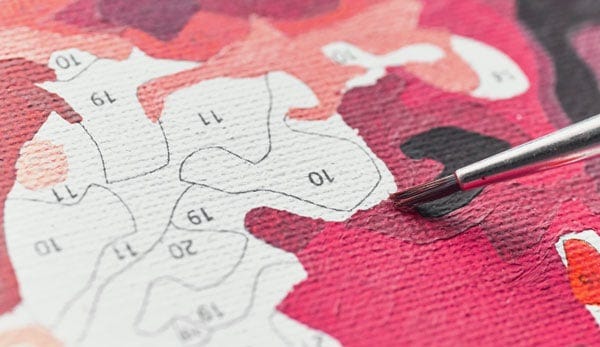
You can have every piece right, all of them joined neatly together in the correct order, and still not have a book worth reading. Writing a picture book isn’t paint-by-numbers. It isn’t a model aeroplane, where you place piece A, then piece B, then piece C, and you get the neat, perfect product at the end. You can follow every step of the formula, mechanically and correctly, and a wonderful book still won’t come out the other side. Because the thing that makes it wonderful is the way all those parts come alive together, and that spark isn’t something you can create from a formula.
The authors who wrote the most masterful picture books started from the structure, and then they moved beyond it. They broke out of the shell and created something even more beautiful, something a little unexpected, something no formula would have given you. That’s what being an artist is. It’s using your imagination and original ideas to create something new.
A machine doesn’t do that. It recombines patterns it has already seen. It can’t imagine.
And while it’s great to know the structure so well that you can move beyond it, breaking the rules isn’t the goal either. Even when you stick exactly to the most common story structures, it’s the small human touches that still make the story special. Some of the best books follow the structure perfectly, but have such distinct voice, an incredibly lovable character, or humour, that make them widely loved.
You don’t run through the formula A, B, C, D, E and presto!, you have a great book. You get a great book from the human touches only you can add (and studying writing craft).
What I see when I read manuscripts
I read a lot of manuscripts, since I coach authors, and I give manuscript feedback.
The manuscripts that truly delight me are always one of a few things. Mainly, the author did something I didn’t expect. I thought the story was heading one way, and then it turned. Or the voice came through so strongly that I could feel the author’s humour and warmth right there on the page. Or the character is just so darn loveable or relatable that I’m rooting for them all the way. Those are the ones I remember.
But even the manuscripts that are just medium to good, the ones that still need work, still feel warmer and more alive than an AI one. Even when the author didn’t make the perfect word choice, or the plot has some weaknesses, it still feels like a real person talking to me. It still feels human to human. And that connects with me in a way that a hollow AI “shell-manuscript” can’t.
I’ve also seen some authors, when they get to this point, use AI to “improve” their manuscript. Please don’t do that, because once AI starts writing even parts of your book for you, things are heading down the wrong path.
Your imperfect, human, still-in-progress book is worth more!
Over to You
This week, I’d love you to do one thing: recommit to learning your craft.
I know that’s a big task that takes time. So just take one step this week. Go read a few of the top picture books and dissect them to see what makes them great. Or go watch a training on writing craft, or read a book on writing craft. Or type out a few of your favourite picture books and see what they look like as manuscripts. Anything that helps you become a better writer!

As I said earlier, I read a lot of manuscripts (and books), and I’m sure many of you have also read hundreds of picture books. You would think that you’d get to a point where there’s nothing new, nothing that excites or touches you, but that’s simply not true.
Every time I read a beautiful manuscript by one of my students or clients, it reminds me why what we’re doing is so important. You can read a thousand stories and still read one today that moves you to tears or makes you smile from ear to ear. A child is going to read that book, and it’s going to help them in some way, maybe for years to come.
It’s definitely worth being one of the people who still puts in the time and care to write a wonderful, human book!